
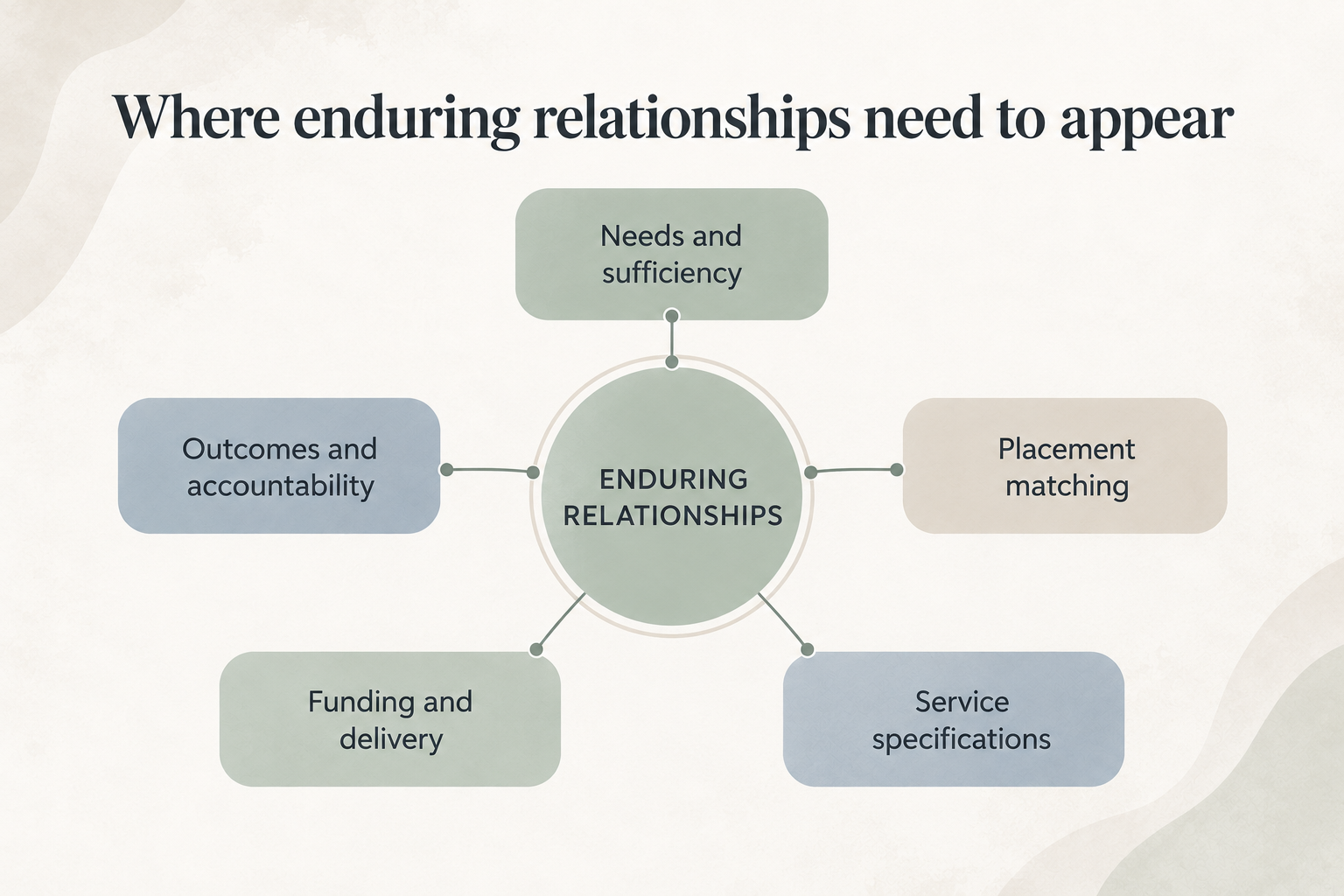
The government’s new policy makes enduring relationships a central objective for children in care and care leavers. Turning that ambition into children’s everyday experiences will require changes to sufficiency planning, placement decisions, service specifications, funding and accountability.

Becoming a foster carer has made the importance of relationships feel much less theoretical.
Children do not come into care as a blank page. They bring people, memories, loyalties, love, loss and a need to understand where they belong.
I have seen the difference it can make when children are supported to maintain relationships with their family. These relationships can help preserve a sense of identity and continuity at a time when much of the child’s life may be changing. They can reassure a child that entering care does not mean every person and connection from their previous life has simply disappeared.
But it is not always straightforward.
Family time can bring excitement, comfort and joy. It can also bring anxiety, disappointment, confusion or renewed feelings of loss. Arrangements change. Adults do not always do what they have promised. Relationships that matter deeply to a child may also involve risk or complexity.
Supporting an enduring relationship does not mean assuming that every relationship should continue in the same way, regardless of the circumstances. It means taking the relationship seriously: understanding what that person represents to the child, listening to the child’s wishes, assessing what is safe and providing the practical and emotional support needed around it.
It can also mean supporting foster carers, residential staff and families to hold some very complicated feelings alongside the child.
A significant change in direction
The Department for Education’s new policy paper, Enduring relationships, describes trusted and lasting relationships as the “golden thread” that should run through the care and leaving-care system.
Importantly, relationships are defined by the child. They may include parents, brothers and sisters, extended family and former carers, but also friends, neighbours, teachers, youth workers or another trusted adult.
The policy is explicit that the sector should begin acting now. It also recognises that this cannot be achieved through the efforts of individual social workers, carers or other practitioners alone. The organisational conditions surrounding them must make relationship-focused practice possible.
That is where commissioning becomes central.
The services we commission, where they are located, how they are funded, the outcomes we specify and the information we monitor can either protect a child’s relationships or make them harder to sustain.
If enduring relationships are genuinely to become a central measure of good care, they will need to be visible throughout the commissioning cycle.
1. Needs assessment and sufficiency planning
Sufficiency is often discussed in terms of whether there are enough foster homes, children’s homes or supported-accommodation places.
The new policy invites a broader question: are there enough of the right homes, in the right places, to enable children to retain the relationships that matter to them?
In 2025, 22% of children in care were living more than 20 miles from their home community. Distance does not automatically mean that a placement is wrong, and some children will need to live further away for their safety or to access specialist provision. But distance can affect much more than travel time.
It can disrupt relationships with siblings, wider family, friends, school staff, health professionals and community groups. It can make family time more difficult and expensive to arrange. It can also leave children dependent on professionals to maintain connections that previously happened naturally.
Sufficiency strategies could therefore consider:
where children’s important relationships and communities are located;
the effect of placement gaps on family time, education and friendships;
access to local therapeutic and family-support services;
the availability of foster and residential homes able to support relational continuity;
gaps in reunification, family-finding, mentoring and sibling support;
how regional commissioning arrangements will preserve local connections.
This is particularly relevant as Regional Care Cooperatives take a greater role in analysing need, publishing sufficiency strategies and developing provision across groups of local authorities.
Regional planning may create greater purchasing power and more flexible provision, but it will still need to remain connected to the individual places and relationships that matter to children.
2. Placement matching and care planning
Placement matching inevitably involves balancing multiple factors: safety, the child’s needs, carers’ skills, education, location, availability and cost.
The shortage of suitable homes can mean that urgent needs take priority. But when relationships are not considered at the point of matching, children may experience losses that are difficult to repair later.
This suggests some additional questions for placement and care-planning processes:
Who does the child identify as important?
Which relationships provide safety, identity, continuity or belonging?
What might be disrupted by this placement?
What would be needed to maintain those relationships safely?
How will the placement support siblings and wider family connections?
What support will the child, family and carers need before and after family time?
What will happen to relationships with foster carers, friends or trusted professionals if the child moves or returns home?
Children’s views must be central, alongside professional judgement about what is safe and appropriate.
This should not become another form to complete. It needs to shape the decision itself and the resources attached to it.
3. Service specifications and provider expectations
Many services already describe themselves as relationship-based or trauma-informed. The next step is to make clear what this means in practice.
Specifications for fostering, residential care, family time, therapeutic provision, advocacy, leaving-care support and related services could include expectations around:
identifying and recording the people who matter to each child;
involving children in defining their own relational goals;
maintaining safe family, sibling, friendship and community connections;
preparing children and adults for family time and supporting them afterwards;
avoiding unnecessary changes of worker or practitioner;
supporting relationships through placement moves and other transitions;
family finding and rebuilding relationships that have been lost;
working with foster carers, birth families and wider networks;
contributing to reunification planning where this is right for the child.
Providers will also need clarity about how these expectations fit with safeguarding, information sharing, confidentiality and professional boundaries.
Enduring relationships should not become a phrase added to existing specifications without any corresponding change to delivery.
4. Funding relationships properly
Maintaining relationships takes time, skill and practical coordination.
It can require transport, appropriate venues, staff time, therapeutic support, advocacy, digital access, activities and flexible arrangements outside conventional service hours. Foster carers and residential teams may need help to prepare children, respond to difficult emotions and support relationships that are important but complicated.
These requirements have a cost.
If commissioners describe relationships as central but do not fund the work required to sustain them, responsibility will fall to individual carers, practitioners and families to make arrangements possible around the edges of already stretched services.
That will lead to inconsistency.
Commissioners should therefore test whether pricing models and contract arrangements recognise the real work involved. This might include reviewing:
assumptions about travel and transport;
staffing levels and continuity;
support before and after family time;
therapeutic consultation for carers and teams;
flexibility within service hours;
coordination with schools, families and other providers;
support during transitions and reunification.
Relationships cannot be important in principle but left unfunded in practice.
5. Outcomes, evidence and accountability
Commissioned services frequently collect information about activity: referrals received, sessions delivered, contacts completed or placement stability.
These measures remain useful, but they do not necessarily tell us whether children feel connected, supported or that they belong.
The government intends to introduce a new enduring-relationships measure, developed with local authorities and informed by meaningful conversations with children and young people. It is expected to become part of the children’s social care dashboard and inform future inspection frameworks.
Commissioners and providers do not need to wait for the final measure before considering what their existing evidence shows.
Useful questions might include:
Does the child have at least one trusted person they believe will remain in their life?
Have important relationships been maintained through placement changes?
Does the child feel listened to when decisions about relationships are made?
Are family and sibling arrangements safe, meaningful and reliable?
Has the child’s network strengthened or reduced?
Do children feel connected to their identity, community and culture?
What do children say has changed as a result of the service?
Numbers alone will not provide the complete answer. Children’s experiences and their own definitions of stability and belonging will be essential.
What does this mean for providers?
For providers, this creates both an opportunity and a challenge.
Organisations that already support family relationships, reunification, mentoring, family finding, therapeutic care, foster carers or care leavers may find that their work has greater strategic relevance.
However, providers will need to demonstrate more than an intention to work relationally. They should be able to explain:
what they do differently because relationships matter;
how children influence decisions about the people in their lives;
how they balance relationships with safety and stability;
how they work with families, carers and the wider professional network;
what evidence they collect about continuity, connection and belonging;
how their service contributes to the child’s wider plan.
This provides an opportunity for commissioners and providers to develop measures together, rather than imposing indicators that are easy to count but tell us little about the child’s experience.
Questions for commissioners and service leaders
The new policy provides a useful lens through which to review existing arrangements:
Where are enduring relationships currently visible in our commissioning intentions and sufficiency strategy?
Do our needs assessments consider relational and community connections?
How do placement decisions account for the relationships a child may gain, maintain or lose?
Do our specifications explain what relationship-focused delivery looks like?
Are providers funded to undertake this work properly?
What do our current outcomes and KPIs tell us about belonging and continuity?
How are children and care-experienced adults shaping our approach?
Are our systems helping practitioners protect relationships—or unintentionally placing obstacles in their way?
From policy ambition to everyday experience
Safety will always matter. So will stability. But belonging matters too.
These should not be competing objectives. Safe and lasting relationships can be part of what creates stability and helps children thrive.
The government’s new direction is therefore welcome, but its impact will depend on whether it changes children’s everyday experiences. If enduring relationships appear in strategies but remain absent from placement decisions, service models, funding and monitoring, the opportunity will have been missed.
The test is not simply whether services describe themselves as relationship-based.
It is whether children leave care with people in their lives who know them, care about them and will still be there when professional involvement ends.
Fiona Corless is the founder of FL Collaborative Consulting. She draws on senior children’s-services commissioning experience, professional practice and her experience as a foster carer to help commissioners and providers translate policy into practical and sustainable service design.